I recently published an article about Sony (
SNE) and how I believe it is wise to
buy the stock hand over fist.
Judging from the sentiment in the comments to my article, it is pretty
clear that this is a hated trade. I believe that Sony is the trade of
the year and possibly the next few years. The reason has to do with
valuation and a key catalyst in the falling yen.
Recently,
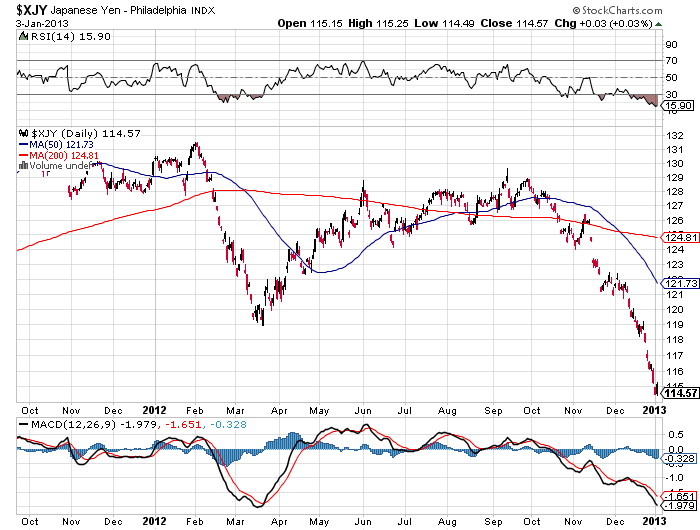
investors have taken notice that the yen is starting to fall. After
bottoming out at 75, the U.S. dollar to Japanese yen conversion rate has
risen to 89, an increase of almost 20% over the past year, the majority
of which has come since September 2012. The Nikkei has correspondingly
moved to new 52-week highs. Much has been written about Shinzo Abe's
return to power in Japan and how he has pledged to strip the Bank of
Japan of its independence if it doesn't support him in his goal of
targeting 2% inflation. While there is still debate about his true
intentions, with some analysts suggesting that he is merely posturing
and won't follow through with actions, the charts of the yen and the
Nikkei suggest that there is more to this than just words.
While
the charts of the yen and the Nikkei are both oversold and overbought,
respectively, in the short term, it is important to keep in mind that
both were in decades long trends that have only just begun to reverse.
As a result the move could be both very powerful and very long in
duration.
What we have seen with the yen is that when a country
operates with a current account surplus the currency of that country is
extremely strong. A current account surplus -- the sum of the balance of
trade (net revenue on exports less the payments for imports), factor
income (earnings on foreign investments minus payments made to foreign
investors), and cash transfers -- increases a country's net foreign
assets by the corresponding amount, and a current account deficit does
the reverse. Both government and private payments are included in the
calculation. It is called the current account because goods and services
are generally consumed in the current period.
Since 2005 Japan
has had seven prime ministers, and over this time period the government
has gotten little done because it has been constantly rotating through
leaders. In this scenario, a government without the ability to pass
through major reforms or policies is unlikely to spend money. Japan is
the epitome of this: After a devastating tsunami and earthquake in 2011,
Japan couldn't even pass a substantial rebuilding plan because of a
lack of leadership. This has seemingly changed with Prime Minister Abe
being re-elected on the platform that he would re-start the country's
economic engine in part by putting through massive fiscal and monetary
stimulus packages.
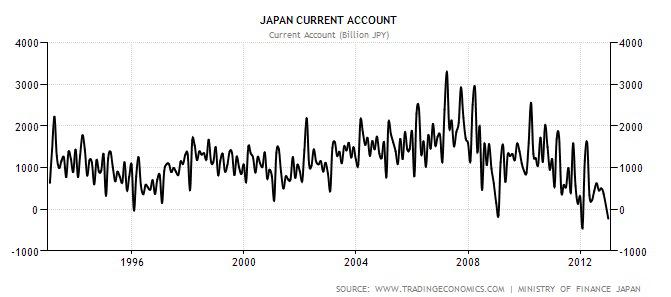
While this has been going on, Japan's current
account has been deteriorating in recent years. Japan's seasonally
adjusted monthly current account balance is shown below:
Click to enlarge images.
 As you can see
,
the trend is clearly downward, and in December the deficit was the
second-largest deficit over the past 20 years (the largest was earlier
in 2012). Keep in mind this occurred
before the proposed approximate $117 billion fiscal stimulus package had been voted on or put into place.
So
what does this all mean to investors of SNE? Well, a weak currency
cheapens the price of a country's exports, making them more attractive
to international buyers by undercutting competitors. As a result, even
the smallest move in the yen has a big impact on Japan's exporters.
Consider Toyota Motors (
TM), one of the country's largest exporters, which says
a fluctuation of just one yen against the dollar
results in a rise or fall in operating profits of $397 million over the
course of a year. SNE is a huge exporter as well, having generated
roughly 70% of revenues in 2011 overseas.
With the current account
surplus turning into a deficit and with the government's intentions of
passing through massive stimulus plans, the yen is likely to weaken
significantly from here. While the yen is currently oversold and could
go through a consolidation or bounce here, the likelihood of it
continuing its fall is quite high.
If you combine this catalyst
with its current valuation you get the recipe for a major move in the
price of SNE's stock. Consider the following valuation metric: price to
sales. Based on 2012 revenues, here is a list of the price to sales of
some of the players in electronics and computers:
- SNE: 0.14
- Hewlett-Packard (HPQ): 0.27
- Dell (DELL): 0.4
- Nokia (NOK): 0.43
- Research In Motion (RIMM):0.68
- Samsung (SSNLF): 1.10
- Apple (AAPL): 3.08
Even
after accounting for its recent convertible bond offering, SNE is worth
one-fifth the value of RIMM and one-third the value of NOK based on
price to sales. Think about this. Why do Nokia and RIMM deserve to be
valued at a 200% and 400%, respectively, premium to SNE?
Movie Studios, for One
When
looking at the valuation of SNE, which currently stands at around $11
billion, one has to look at the sum of its parts. With operations in
movie studios, music, computers, cameras, cell phones, medical
equipment, and many more areas, it can be difficult to assign a value to
SNE as a whole. However, in looking at just one of the parts of its
business, you get a sense for just how undervalued SNE is.
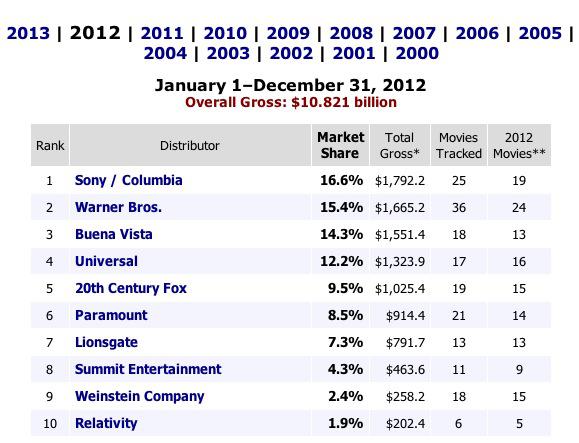
Consider the case of Sony/Columbia Motion Pictures. This division
generated $8.1 billion in revenues in 2012,
roughly one-tenth of SNE's revenues and it had a 16.6% market share,
which ranked it No. 1 in the movie industry. By comparison, Lions Gate (
LGF)
had a 7.3% market share and has a market cap of $2.4 billion. SNE had a
market share 2.27 times larger than LGF, so using simple math one could
assume that SNE's motion picture business should be worth 2.27 times
the market cap of LGF, or $5.5 billion. That means that the remaining
90% of SNE's business is currently only worth $5.5 billion.
That is, the remaining portion of SNE's business trades at a price to sales ratio of 5.5 / 72 = 0.08.
 Estimates for 2013
Right
now, the consensus estimate for the year ending March 31, 2014, is for a
profit of $0.92 for SNE. However, these estimates were made over the
summer of 2012, prior to the most recent move in the yen. For every
one-point move in the yen against the dollar, it is estimated that SNE's
profits rise or fall by $30 million over the course of a year. Since
the summer of 2012, the USD/JPY has risen 12 points. That alone could
generate an additional $0.35 to $0.40 EPS. However, I believe the move
in the yen is just getting started. After a period of near-term
consolidation to work off an oversold condition, you could see a move in
the USD/JPY to at least 110 (it is currently at 88) -- which could
generate a total of $1.00 additional EPS for the company.
Just as
importantly, the company has been going through a massive restructuring,
paring down assets and focusing on its core strengths of mobile,
digital imaging, gaming, and medical equipment. These cost cutting
measures could add significantly to the bottom line. In June, Sony
sold off its chemical operations business to a government-backed bank for $730 million and they are
looking to sell their lithium ion business, estimated at $630 million and a corporate office building in Tokyo
for $1 billion to $1.5 billion. These measures will help the company cut costs and raise capital to help focus on its core strengths.
Sony is
projecting a modest drop
in revenue for the fiscal year, ending March 2013, down to $83 billion
from $85 billion compared to its earlier August forecast. The firm said
its operating income projections stand at $1.6 billion as a result of
new products and recent acquisitions.
Apple and Everyone Else
Over the past four months, I've written extensively about how
Apple is dead money at best.
I've argued that the major catalyst for its move to $700 came from the
launch of the iPhone on all major carriers in the U.S. after the
exclusivity contract with AT&T expired. The result of this has been
what appears to be at least an intermediate top in Apple, but, more
importantly, money has begun to flow to Apple's competitors that were
previously left for dead: NOK is up 175% from its lows, RIMM is up 127%
from its lows, and HPQ and DELL are up 50% from their lows. I believe
SNE is next and is currently being ignored by investors.
Combine a
shift in investor sentiment away from Apple with an extremely low
valuation, a falling yen that by some estimates may have already added
$0.40 in EPS, and a major cost cutting and corporate restructuring
program and you have the potential for a huge winner in 2013 and 2014 in
SNE. With these catalysts, there is the potential to generate $3 to $4
EPS within two years, something no one on the the Street is expecting.
If this happens it is likely that the market could price the stock at 15
times earnings at some point, and you could see the stock price
approach its old highs from 2007 of $50 to $60 per share.
The best
part is while the recent move in the yen has sparked a major move in
the Nikkei, SNE's stock price has only moved up marginally. Volume has
been very heavy while the stock has traded sideways for five weeks,
often a sign of a heavy accumulation.
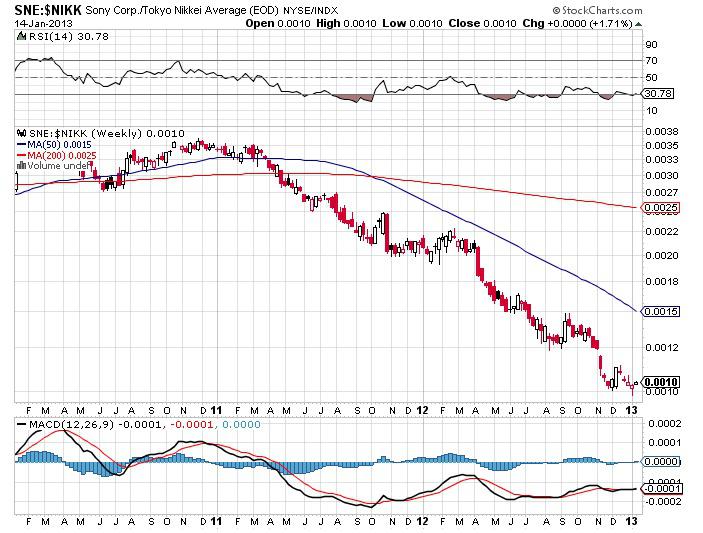
Below is a chart of the
ratio of SNE's stock price to the Nikkei. As you can see, SNE's stock is
underperforming the overall Japanese market. I believe this will change
shortly.

First
things first, though, SNE is currently benefiting from a move in the
yen, which I believe is the spark that starts the fire. I am long SNE at
prices between $9.90 and $11.50. I would recommend buying it at any
price below $15.00.


 大衣
 针织衫/毛衣
 内衣
 高跟鞋
 雪地靴
 靴子
 手提包
 钱夹
 项链
 围巾/丝巾